ENCÉFALO Speaker Program
Program for physician speakers in medical aesthetics
The ENCÉFALO Speaker Program brings together the tools to prepare a scientific talk on published evidence: a weekly newsletter, article sheets, an image bank with its credits and a studio that builds your complete talk. It is made by the ENCÉFALO team, a multidisciplinary research group in medical aesthetics.
Starting point
Preparing a scientific talk takes work the audience never sees. You have to read the full article, find the page where each figure appears, know who paid for the study and decide how far a result can be claimed. Then you have to find an image you can project with its license in order, and cite the source correctly.
The program does that work with you. Every data point comes with its source, every study with who funded it and every figure with its credit. Which data you take to your talk, and how you tell them to your colleagues, is your decision.
Every figure said on a stage ends up, sooner or later, in a colleague's practice and in front of a patient. That is why, in the program, every message travels with its limits.
Weekly newsletter
Every Monday a new edition reaches the members area with the week's articles. Efficacy and safety articles are marked separately, and each edition explains the abbreviations you will find in it.
Each article in the newsletter includes:
- One key message and two or three numbered messages for your slide.
- The main finding, with the study design and the product evaluated.
- A section called "What you need to know", with the study's limits, to answer questions from the audience.
- Funding and conflicts of interest, in a separate box.
- The full reference, with its DOI and the page of the article each data point comes from.
ENCÉFALO does not take sides for any brand and does not recommend products. Brand names appear exactly as each study declares them, so you know precisely what was evaluated.
Articles
Articles are the raw material of the program: recent studies, published in scientific journals, on injectables and facial anatomy. In the newsletter each article arrives as a short note. Some are also worked through in depth, in an article sheet.
In the members area you will find every article that has a sheet, each with its title in Spanish, its original title, the journal and its level of evidence.
Article sheets
Each sheet takes a single article and explains it in four pages. You can read it on the web or download it as a PDF. It is built in the order you need it while preparing a talk.
Material for your slide
- One sentence on why the study matters to you.
- Messages ready to project, each with the page of the article it comes from.
- The citation to copy, and a clipping with the title, authors and journal, ready to put on screen.
- The main idea of the article, what it covers and what type of study it is, explained in plain words.
Backup for questions
- Who paid for the study, with the authors' original statement.
- A box called "Don't say this in your talk", with the claims the study does not support and the reason for each one.
- The level of evidence on the Oxford scale (OCEBM), with the pyramid explained and the article's place in it. ENCÉFALO assigns that level, and the sheet says so when the journal does not assign one.
- Questions and answers on what the audience may ask: whether the study proves cause, who rated the results, which patients the findings can be extended to.
- A figure: the article's own when it can be shared, or an ENCÉFALO illustration made for that sheet when the article's images cannot be shared.
- A glossary of the study's concepts.
The sheet lets you go on stage knowing what the study says, what it does not say and who paid for it, so that every answer you give has the article's page behind it.
Image bank
Facial anatomy images for your slides, with a search tool. You type a word (lips, temple, masseter) and the bank looks for it in the title, topic, regions, structures, description, caption and uses. Accents and capital letters do not matter, and the search recognizes synonyms.
Each image includes:
- A code, the facial region and a title in Spanish.
- The image in high resolution, to enlarge or download.
- The article's original caption in English, with the figure number, the page and a link to the source article.
- A description of the image, suggested uses for organizing a class and its limits, for example when a diagram has no scale or does not show the vessels. Suggested uses help you plan the class and do not replace a clinical recommendation.
- The full source and credit, already written for your slide.
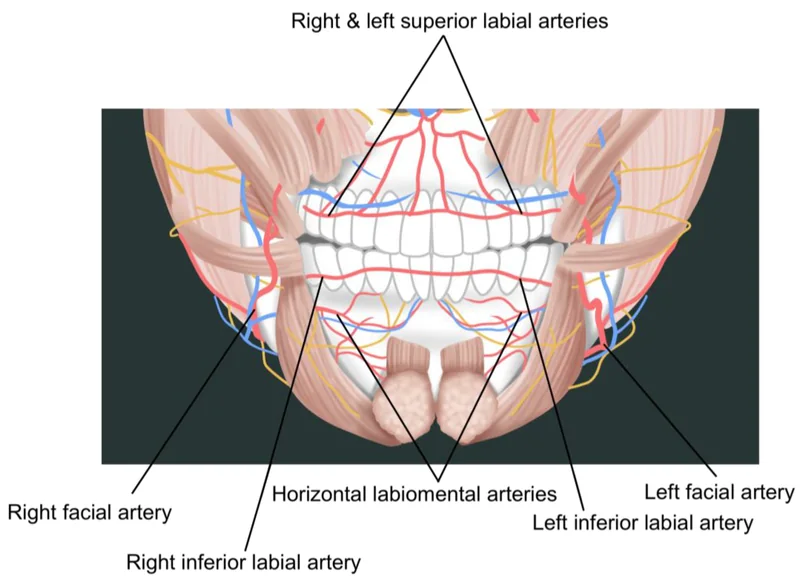
BF-007 · lipsCourse of the labial arteriesHong GW, Choi W, Yoon SE, Wan J, Yi KH. Life 2025;15:315. Figure 6. https://doi.org/10.3390/life15020315. © 2025 the authors. CC BY 4.0: https://creativecommons.org/licenses/by/4.0/. Original editorial image converted to WebP for the web, no other changes. 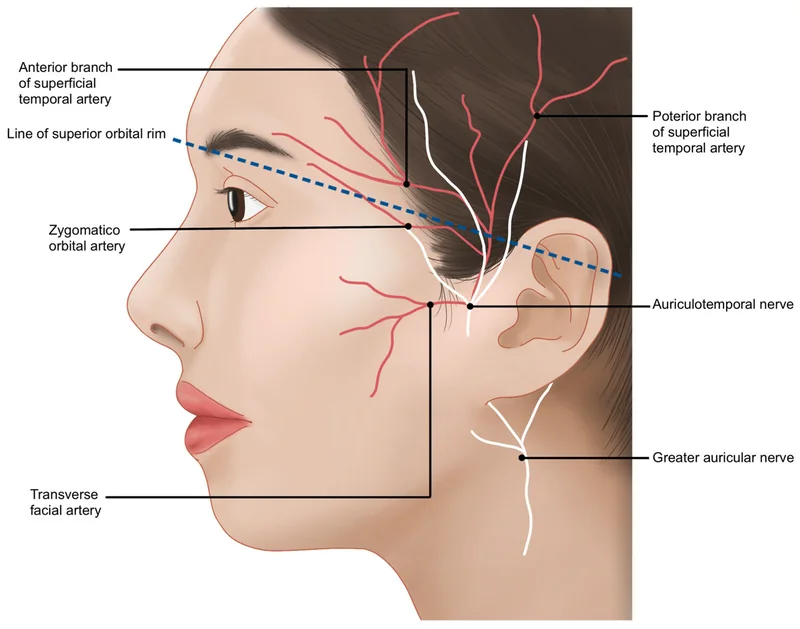
BF-010 · templeCourse of the superficial temporal arteryHong GW, Wan J, Choi W, Yi KH. Life 2025;15:266. Figure 6. https://doi.org/10.3390/life15020266. © 2025 the authors. CC BY 4.0: https://creativecommons.org/licenses/by/4.0/. Original editorial image converted to WebP for the web, no other changes. 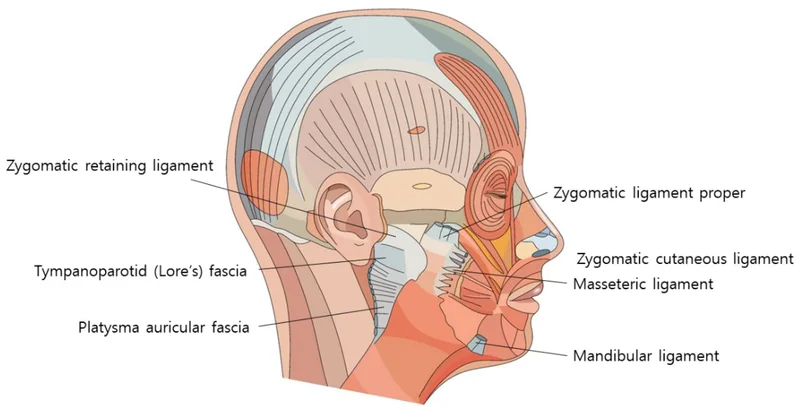
BF-034 · jawFacial retaining ligamentsHong GW, Song S, Park SY, Lee SB, Wan J, Hu KS, et al. Diagnostics 2024;14:716. Figure 16. https://doi.org/10.3390/diagnostics14070716. CC BY 4.0: https://creativecommons.org/licenses/by/4.0/. Original image extracted and converted to WebP for the web, no other changes.
Licenses
Figures from published articles carry a verified CC BY license: you can use them by citing their authors. ENCÉFALO's own illustrations do not carry an open license: they may be used only by members, in their talks and citing the source. The bank lets you filter images by license type.
Speaker Talks Studio Coming soon
International-level medical talks, from the idea to the stage
We are finishing this service. We will email you when it is available.
Speaker Talks Studio is ENCÉFALO's studio that builds scientific talks for physician speakers in aesthetics, dermatology and plastic surgery, mainly for events of sponsoring laboratories. It delivers two things: a talk ready to take on stage and a package to master it. Both are made to your measure.
Speaker profile
Before your first talk we build your speaker profile: your slide pace, your text density, your design style, your colors, your citation style, your affiliations, your motto, your techniques and your publications. Every talk grows out of that profile, not out of a generic template.
- The number of slides depends on you. If you prefer one content slide per minute, that is what you get. If you prefer fewer, with more pauses, that works too.
- The design adapts to your preferences for text density, font size, visual style and citation style, within the sponsor's template.
- If you edit your slides by hand, we compare your changes one by one and add them to your profile. Each new talk comes out closer to you than the one before.
How each talk is built
- Each talk starts from the event, the audience, the minutes available and the sponsor's rules.
- Each talk tells a story: central message, opening hook, narrative sequence and strong close. When there are several talks, a common thread connects them from the first to the last.
- Analogies simplify what is complex without losing rigor.
- Every figure on screen or in your voice is verified in the original article, with its page. Every study carries its design, its sample size, its level of evidence and its declared funding. A data point without a source is removed.
- Your publications enter the talk with confirmed authorship, and citations are shown as a clipping of the article's title and authors, if you prefer.
- Anatomical plates are highly detailed, based on verified anatomical atlases, with conventional colors: red arteries, blue veins, yellow fat and red muscle. The license of every figure is checked before it is used.
- Photographs of your patients enter with consent and at their exact point in the story: the before in the assessment and the after in the close.
- Conflicts of interest and affiliations are declared. The talk follows the approved product labeling, shows visible notices when a use is not approved and makes no comparisons with competitors.
Deliverables
- 01
The final presentation, in pptx and PDF, in a single organized folder. Before delivery we check brands, figures, language, sizes, contrast and notes, and test it on your own computer so it opens without surprises on the day of the event.
- 02
The script slide by slide, with the on-screen text, the full voiceover and the citation, calibrated to a natural pace.
- 03
Speaker notes, clean and ready to read at the lectern.
- 04
The list of points for the meeting with the sponsor.
Study package for each talk
A study video of 10 minutes or more that reviews the talk slide by slide, in your name and your event's.
An explanatory audio, to review in the car or at the gym.
A training audio: a critic raises the toughest scientific objections and another voice answers them with the evidence. That way no question from the audience catches you off guard.
An infographic with the structure of the talk in a single image.
Benefits
- You prepare your talk on the original article: every data point comes with the page it comes from.
- You know who paid for each study before you project it, and you can say so on stage.
- You answer hard questions with the design, the limits and the level of evidence of each study at hand.
- You project images with their license or credit already settled, without hunting for permissions at the last minute.
- You save the work of citing: the reference and the title clipping are already written.
- Your talk keeps your style, because the studio learns from your changes and each talk comes out closer to you.
- You arrive at the event with a script, notes, a study video and training against the toughest objections.
- You talk science without acting as a salesperson: the program does not recommend brands, and every talk from the studio declares its conflicts of interest.
Contact
Want to join the ENCÉFALO Speaker Program, or have a talk coming up? Write to us at info@encefalo.org.
LET'S BRING BACK MEDICINE TO AESTHETICS